This site is not a shop. Prowse & Hargood ceased trading and the company behind it was dissolved. This collection covers the house's shirts, cloth and craft. Nothing here is for sale, no order can be placed, and no prices, ordering routes or contact details are provided. More about Prowse & Hargood.
A Glossary of Shirtmaking
Prowse & Hargood published this glossary because it sold without a shop, and a customer who cannot handle the cloth needs the words for it instead. The house's definitions are lightly expanded where a modern reader would want a sentence more. It runs from the diagonal of a tie's blade to the panel across a shirt's shoulders.
B
Bias. The diagonal direction of cloth. Ties should be cut on the bias — especially the blade — otherwise the tie will twist when worn. This is the single most consequential decision in tie construction: a strip of woven silk cut straight along the warp has no give and will not hang; cut at forty-five degrees, it stretches evenly in every direction, absorbs the tension of a knot and returns to shape overnight.
C
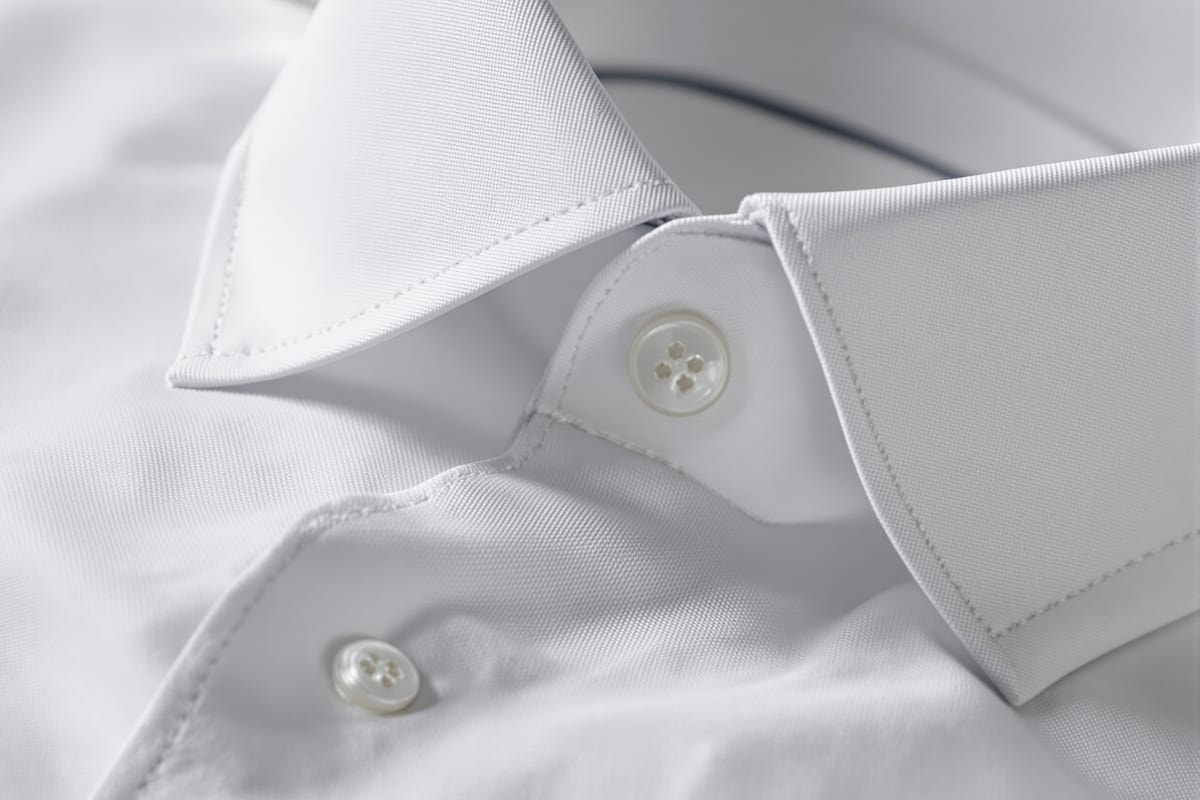
Collar. The Tewkesbury range all have collars that are non-fused, with a woven interlining. The Tuscany range have fused collars. The distinction matters to how a shirt ages. A fused collar is bonded to its interlining with adhesive and holds a crisp line straight from the packet; over many hot washes that bond can eventually fail and bubble. A non-fused collar is stitched rather than glued, sits a little softer at first, and tends to keep its shape for the working life of the shirt.
Collar stiffeners. Plastic strips that run down the inside of the collar to ensure the collars remain smart throughout the day. Removable — and they must be removed before washing.
Cuffs. The majority of these shirts came in both single and double cuff. The single cuff shirts have two buttons; the double cuff shirts have two buttonholes for cufflinks.
Cufflinks. Fastenings for a double cuff, passing through both buttonholes in place of a button. The house carried a compact collection in mother-of-pearl, onyx, haematite and crystal, described on the cufflinks page.
D
Darts. A fold of fabric stitched to a point at one or both ends, giving shape to a garment. Back darts are what separate a fitted shirt from a full-cut one; the Tuscany range used them, the classic Tewkesbury body did not.
E
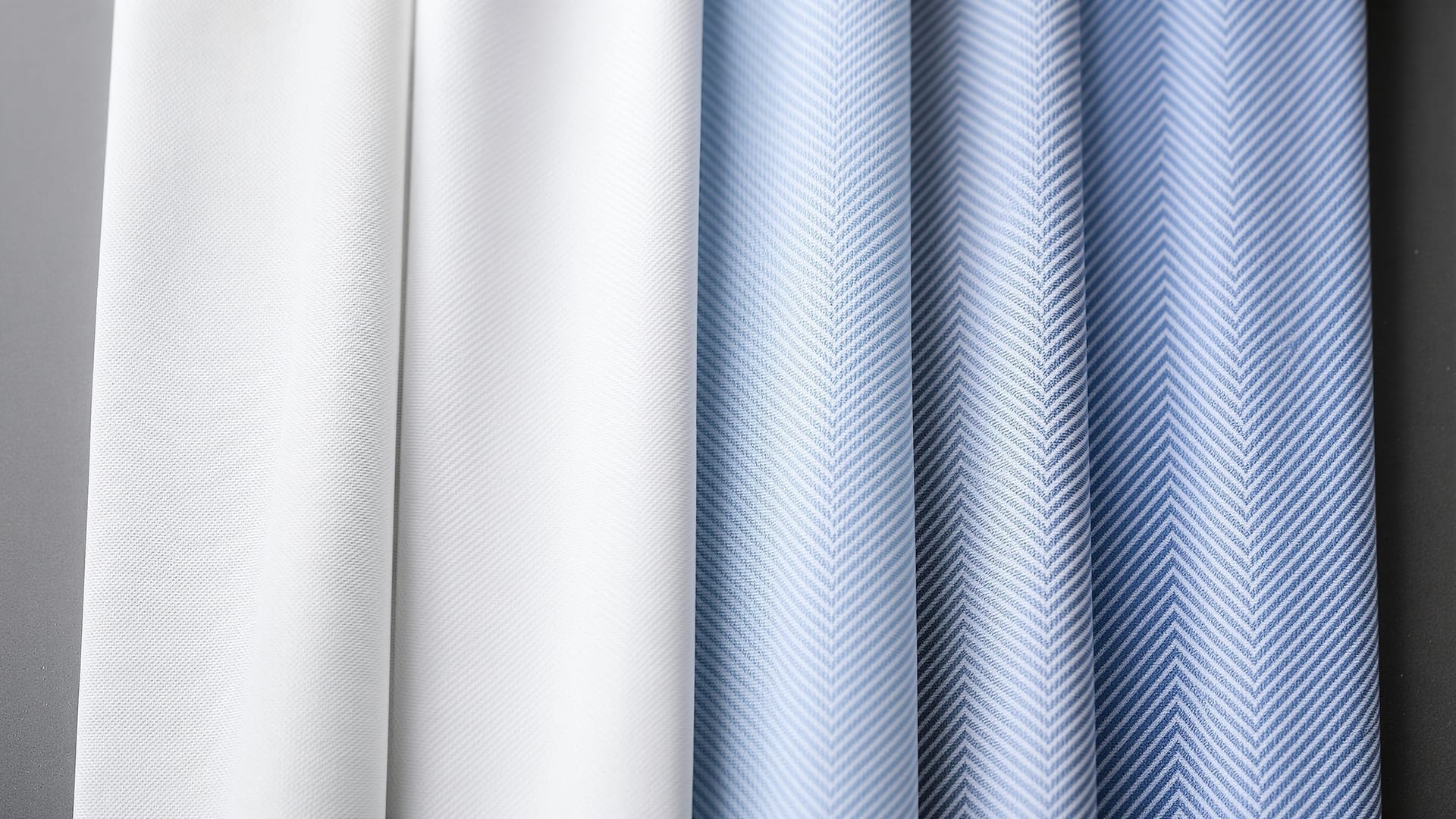
End-on-End. Allegedly invented by the French, who call it fil-à-fil. A fabric where a white thread is interwoven with the coloured thread, end upon end. At arm's length it reads as a soft solid; close up it has a fine flecked depth that a flat poplin cannot produce.
F
Fabric. Cloth made from yarn. Yarn is woven into cloth. The weft threads run widthways and the warp threads longitudinally.
French or double cuffs. Cuffs with square or round edges that turn back on themselves and are worn with cufflinks.
G
Gauntlet. The open part of the sleeve between the cuff and the elbow. A well-made shirt closes it with a small gauntlet button, so that the placket does not gape when the sleeve is pushed up.
Gingham. Fabric with dyed yarns introduced at given intervals, both vertically and horizontally, to achieve block or check effects.
Gusset. The reinforcement at the bottom of the shirt between the front and back. It takes the strain at the point where the side seams end and is a reliable tell of how carefully a shirt was made.
H
Herringbone. A fabric where the direction of the twill is reversed at intervals, producing a pattern resembling herring bones and resulting in a rich, lustrous sheen. It gives a white shirt visible texture without introducing a colour.
Houndstooth. A check with jagged edges resembling a dog's tooth.
M
Mother-of-pearl. The hard, smooth, iridescent inner lining of the shells of oysters, mussels and other molluscs — used for the better class of shirt button and for cufflink faces.
O
Oxford cloth. A plain weave fabric of medium or heavy weight. The majority of oxfords are of combed yarns and are given a silk-like lustre finish. It has a characteristic pebbly basket-weave construction. Royal oxford is its dressier relative — a heavier, more lustrous variation that carries a formal collar well.
P
Pinpoint. A very tightly woven fabric with a very high thread count per inch, making the fabric very soft. A cross between poplin and oxford.
Placket. The strip of cloth that runs down the front of the shirt on which the buttonhole is slit. The width of this is 3.2 cm.
Poplin. Tightly woven, durable cotton made with a plain weave. The default formal shirting: smooth, cool, and the flattest ground for a printed or woven stripe.
T
Tattersall. A uniformly square pattern of lines of two or more colours forming squares on a solid background.
Ties. All of the house's ties were 147 cm (58 inches) long and 9.5 cm (3.5 inches) wide at the widest point, the blade. This is a standard shape and length.
Twill. A weave characterised by diagonal lines on the surface of the fabric, giving a depth of colour and a silky finish.
Two-fold yarn. All of the house's yarn was two-fold: two yarns folded together before weaving. Two-fold cotton is stronger, smoother and holds a press better than a single-fold cloth of the same fibre, which is why it is the standard specification for good shirting.
Y
Yarn. A fine continuous length of fibres, with or without twist, strong enough to be processed into fabric.
Yoke. The panel across the shoulders from which the body and sleeves hang. A split yoke — two pieces joined at the centre back — allows the grain to be angled to each shoulder and is a mark of a better-made shirt.
Where these terms come from
Most of this vocabulary is older than any modern shirtmaker and is defined consistently across the trade. The Textile Institute maintains the standard terminology for fibres, yarns and fabrics, and Encyclopaedia Britannica gives a clear general account of how plain, twill and satin weaves differ. For the objects themselves — collars, cuffs and cufflinks across three centuries — the Victoria and Albert Museum is the best-catalogued public collection in Britain.
If you are trying to buy a shirt in these terms rather than read about them, the sizing guide covers the two measurements you need and the care guide covers keeping the cloth in the condition it arrived in.