This site is not a shop. Prowse & Hargood ceased trading and the company behind it was dissolved. This collection covers the house's shirts, cloth and craft. Nothing here is for sale, no order can be placed, and no prices, ordering routes or contact details are provided. More about Prowse & Hargood.
The Tewkesbury Range
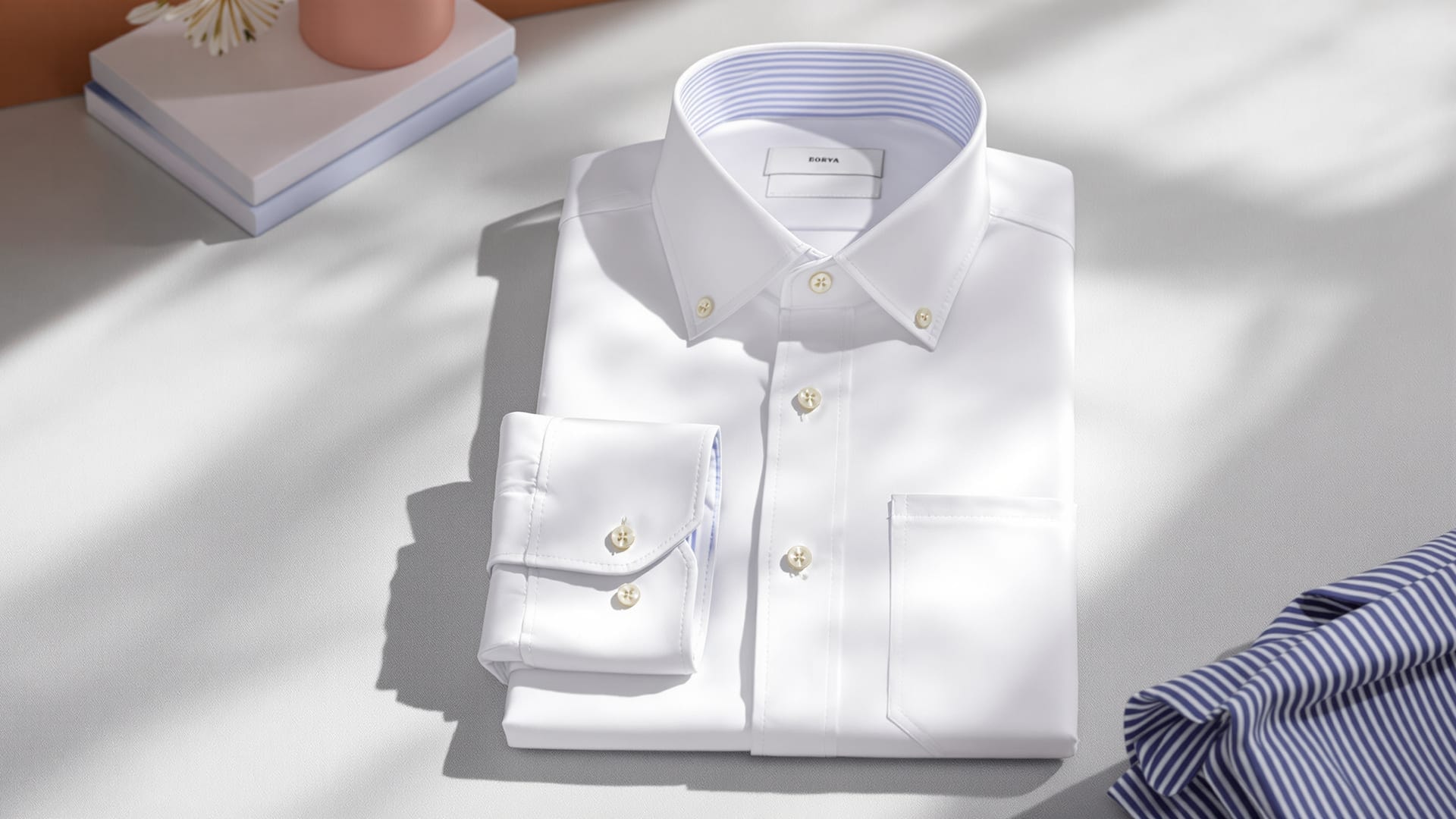
The quintessential classic shirt. The Tewkesbury was the house's formal range and its backbone — English-tailored, made from two-fold long-staple cotton, cut with a non-fused collar and a double cuff, and organised into four families of cloth: Plains, Stripes, Checks and Specials.
In the house's words
Prowse & Hargood's range of English tailored men's dress shirts are made from the best 100% cotton from around the world. They have all been crafted with our no-compromise approach to quality. Choose a shirt from our range of formal or casual styles and complement your shirt with a handmade silk tie and a pair of contemporary or classic cufflinks.
All our shirts are handcrafted from finest 2-fold 100% cotton woven from long-staple cotton for a comfortable, luxurious feel. Our Tewkesbury range of men's shirts are available in double cuff for use with cufflinks. Prowse & Hargood shirts are available in sizes 15 – 18.
Construction
Two details define the range. The first is the non-fused collar with a woven interlining. Rather than bonding the outer collar to a stiffening layer with adhesive, the interlining is a woven cloth held in by stitching. It sits marginally softer out of the packet and takes a knot more sympathetically, and — the real argument for it — it cannot delaminate, which is the failure mode that eventually ruins a fused collar after enough hot washes.
The second is the double cuff, turned back on itself and closed with cufflinks through two buttonholes rather than a button. It is the more formal of the two cuffs and the reason the house carried a cufflink collection at all.
Plains
The foundation of the range and the largest group: white and cream poplin, a pale Pacific poplin, pink poplin, and a tan end-on-end. Poplin is a tightly woven plain-weave cotton — smooth, cool, and the flattest possible ground, which is why it is the default for formal shirting. End-on-end interweaves a white thread with a coloured one so that the cloth reads as a soft solid from a distance and shows a fine fleck close up.
Stripes
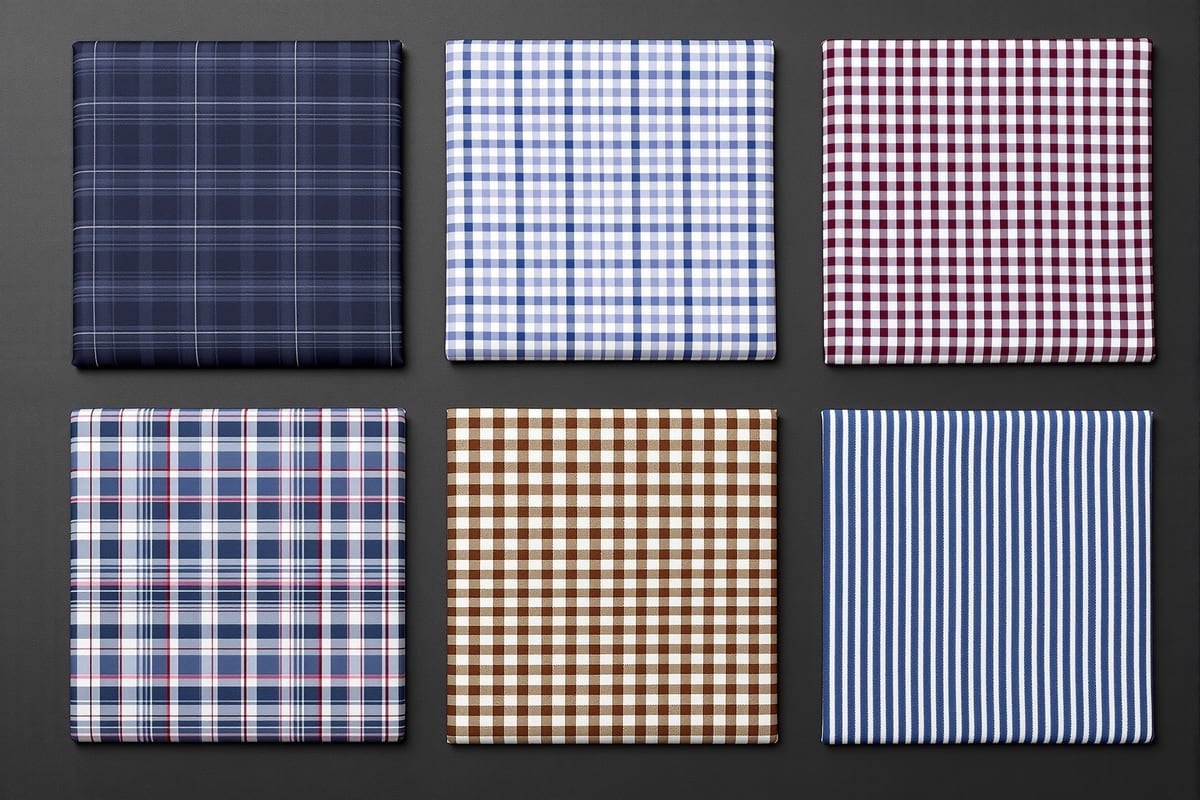
Woven rather than printed, which means the stripe is present in the structure of the cloth and cannot wash out. The range ran across a Blue Jumbo Stripe, a Yellow Taunton, a Blue/Navy Brantham, a Blue/Pink Multi Stripe, a Navy Butcher Stripe and a Purple/Navy Lawford. The butcher stripe — a broad, evenly spaced bar — is the least formal of them; the fine multi-stripes read almost as solids at conversational distance.
Checks
The largest and most characterful group, and the one that carried the house's naming habit: Navy Boxford, Blue/Pink Felsham, Gold/Royal Marwood, Lilac/Royal Marwood, Gold Gingham, Blue/Green Harkstead, Pink Polstead, Wine Saxham, Red Jumbo Gingham, Blue/Yellow Kingarth and Navy/Lime Raydon. Most of the names are East Anglian villages. Gingham, in the strict sense the glossary gives it, is a check produced by introducing dyed yarns at set intervals in both directions rather than by printing over a plain ground.
Specials
A smaller rotating group for the cloths that did not sit in the other three: Pink Herringbone, Lilac Herringbone and a Royal Oxford. Herringbone reverses the direction of a twill at intervals, producing texture and a lustrous sheen without introducing a second colour — which is how a white shirt gets visual interest and stays formal. Royal oxford is the dressier weight of oxford, with more lustre than the everyday basket-weave version.
Sizing
Collar sizes 15, 15.5, 16, 16.5, 17, 17.5 and 18 inches, with sleeve lengths paired to them in a fixed progression. The sizing guide gives the full tables and the house's method for taking both measurements yourself. Anyone outside the standard pairing was directed to the bespoke service.
Wearing it
The Tewkesbury was built to be worn with a tie, and the range's own suggestion was to complete it with a handmade woven silk tie and a pair of cufflinks. Its relaxed sibling, the Tuscany, exists for the days when it will not be. For the vocabulary of weaves used above, see the glossary; for the wider history of the English dress shirt, the Victoria and Albert Museum collection is the standard public reference.