This site is not a shop. Prowse & Hargood ceased trading and the company behind it was dissolved. This collection covers the house's shirts, cloth and craft. Nothing here is for sale, no order can be placed, and no prices, ordering routes or contact details are provided. More about Prowse & Hargood.
Handmade Woven Silk Ties
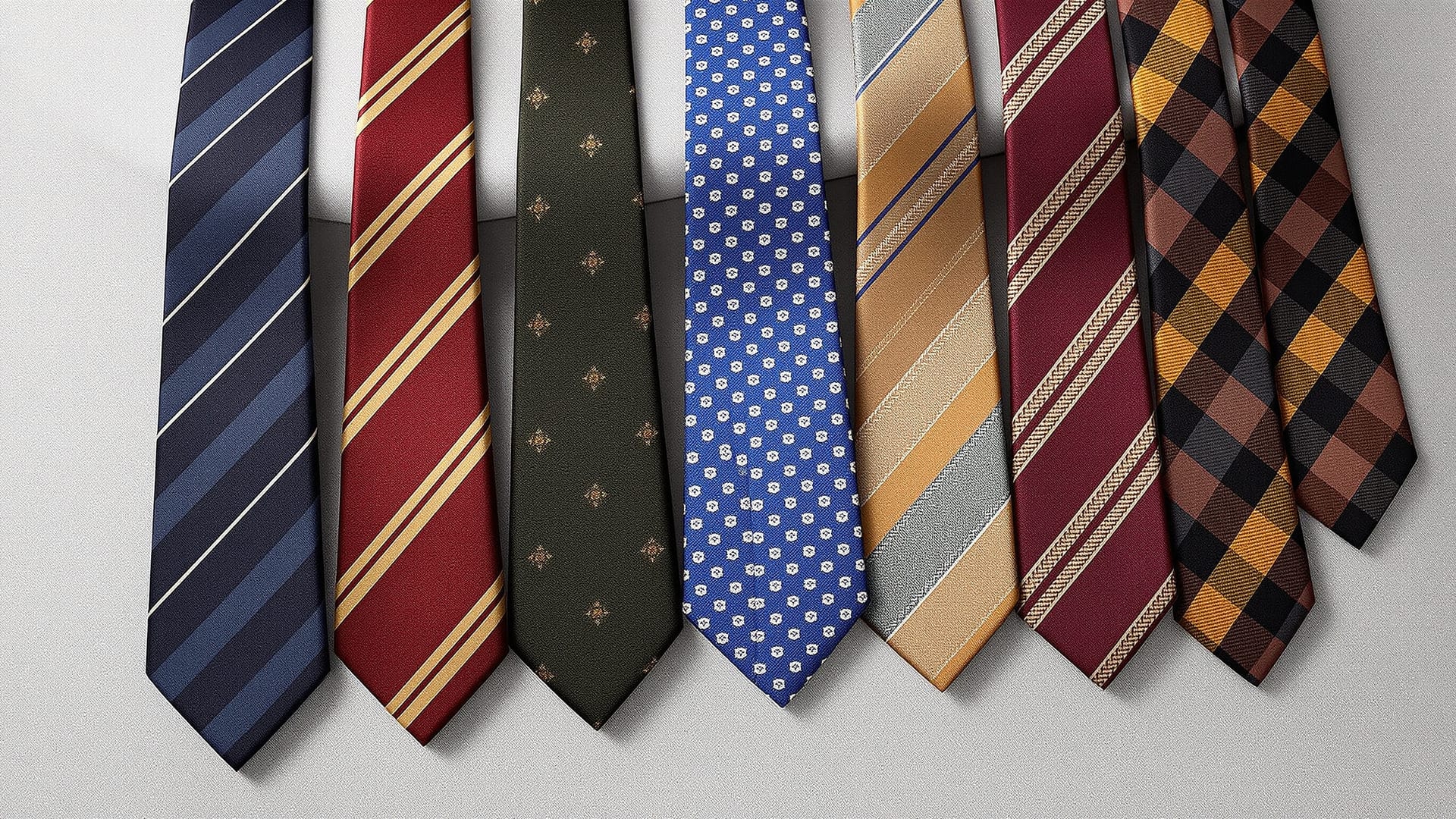
Nine catalogue pages of ties, all of them handmade from woven silk and all of them built to the same specification: 147 centimetres long, 9.5 centimetres wide at the blade, cut on the bias. It was the largest single collection the house carried.
The specification
The house published the numbers rather than leaving them to be discovered. Every tie was 147 cm (58 inches) long and 9.5 cm (3.5 inches) wide at the widest point of the blade — "this is a standard shape and length," as the glossary put it, and it is: 8 to 9.5 centimetres has been the conventional blade width for classic ties for decades, with fashion drifting either side of it and always coming back.
More important than the dimensions is the cut. Ties should be cut on the bias — especially the blade — otherwise the tie will twist when worn. Silk cut diagonally across the weave, at roughly forty-five degrees to the warp, stretches evenly in every direction. That is what lets a tie absorb the tension of a knot, hang straight down the front of a shirt, and recover its shape overnight. A tie cut along the straight grain has no give, and will corkscrew away from vertical no matter how it is knotted.
Woven, not printed
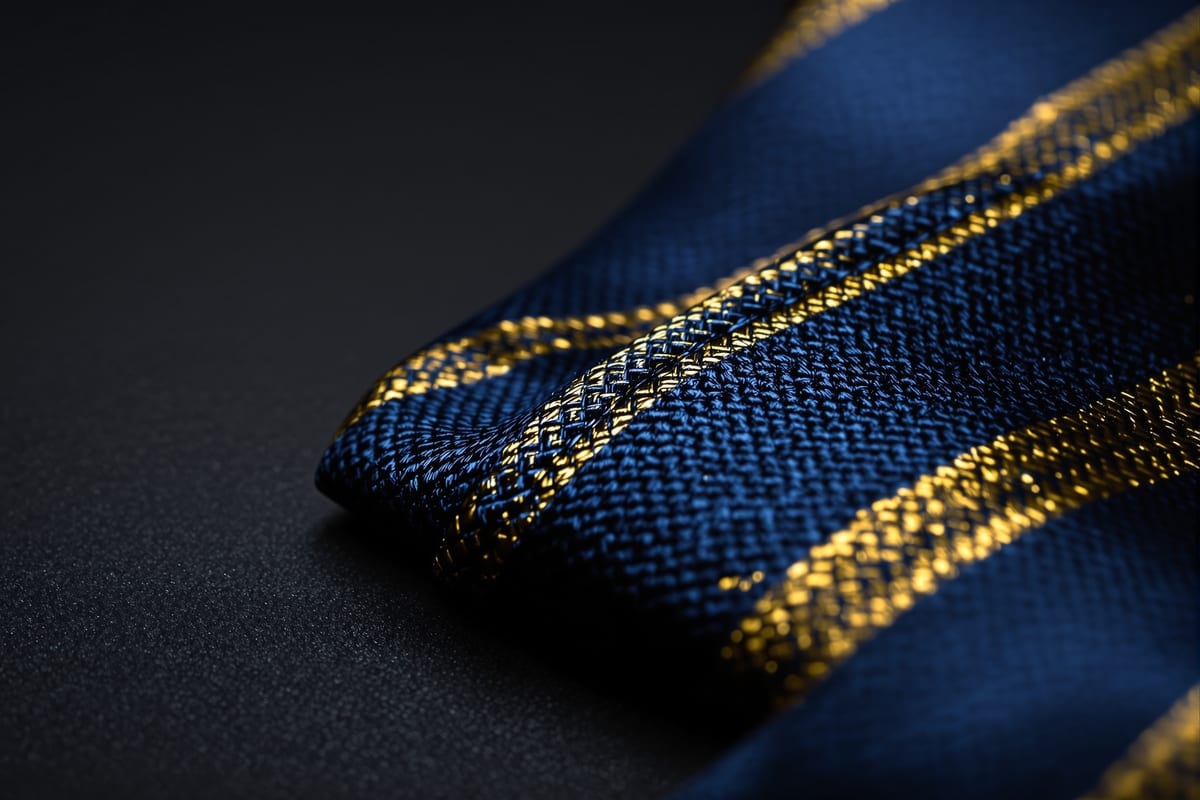
These were woven silks. A printed tie carries its pattern as ink on the surface of a plain ground; a woven tie carries it in the structure of the cloth, built up from coloured warp and weft threads on the loom. Woven silk has more body, catches light differently across the pattern, and does not lose definition with age. It is also considerably slower to produce, which is why a woven tie has always sat above a printed one in the trade.
The collection
The colourways ran across nine pages and fell into recognisable families:
- Stripes — Maroon/Brown, Red/Navy/Gold, Red/Navy, Maroon/Navy, Brown/Tan band, Navy/Blue, Navy/Gold, Green, Navy/Yellow, Yellow/Navy/Brown, Burgundy/Gold/Blue, Navy/Gold/Orange.
- Squares and diamonds — Red/Navy Square, Red/Blue diamond, Lilac/Blue square, Navy/Purple Square, Yellow/Navy diamond, Navy/White diamond.
- Checks — Blue tiny check, Maroon/Brown check, Black/Brown check, Purple/Brown check.
- Paisleys — Blue Paisley, Red Paisley, Gold Paisley.
- Florals and small motifs — Navy/Blue flower, Navy/Orange flower, Copper/Blue/White, Sky Blue/Red, Black/Gold/Brown, Blue/Navy/Orange.
The palette is worth noticing: navy, maroon, gold, brown and green dominate, with almost nothing in the bright or novelty register. This was a collection built to be worn with the Tewkesbury range in an office, and it was chosen accordingly.
Matching a tie to a shirt
The house's own advice was simply to complement the shirt with a handmade silk tie and a pair of cufflinks. The workable principles behind that are few. Scale is the first: a fine multi-stripe shirt and a fine-striped tie fight each other, while a bold stripe against a small motif reads cleanly. Weight is the second: a heavy woven silk overwhelms a Full Windsor and belongs in a Four-in-Hand. Formality is the third: a woven stripe or a small geometric belongs with a plain poplin, and a patterned shirt is generally better served by a tie that is solid in effect even if it is textured up close.
Care
Store ties untied, rolled loosely or hung over a rail, never left knotted overnight. Blot spills rather than rubbing, and send anything serious to a professional dry cleaner rather than soaking a bias-cut silk at home. The care guide explains why each of those matters.
Reference
For the fibre itself — how silk is reeled, degummed and woven, and why it takes dye the way it does — Encyclopaedia Britannica's account of silk is a clear starting point, and the Victoria and Albert Museum holds neckwear spanning the period in which the modern tie took its present shape. The construction terms used above are defined in the glossary.