This site is not a shop. Prowse & Hargood ceased trading and the company behind it was dissolved. This collection covers the house's shirts, cloth and craft. Nothing here is for sale, no order can be placed, and no prices, ordering routes or contact details are provided. More about Prowse & Hargood.
Bespoke Shirts
Each an original, just for you. Alongside its two ready-to-wear ranges, Prowse & Hargood offered a made-to-measure service for customers who wanted shirts cut to their own measurements from a much wider choice of cloth.
The house's case for it
Many individuals wouldn't dream of wearing anything other than a made-to-measure suit. So why aren't bespoke tailored shirts more popular? At Prowse & Hargood, we believe they should be. Which is why we offer a special service for customers who want their shirts individually made to measure.
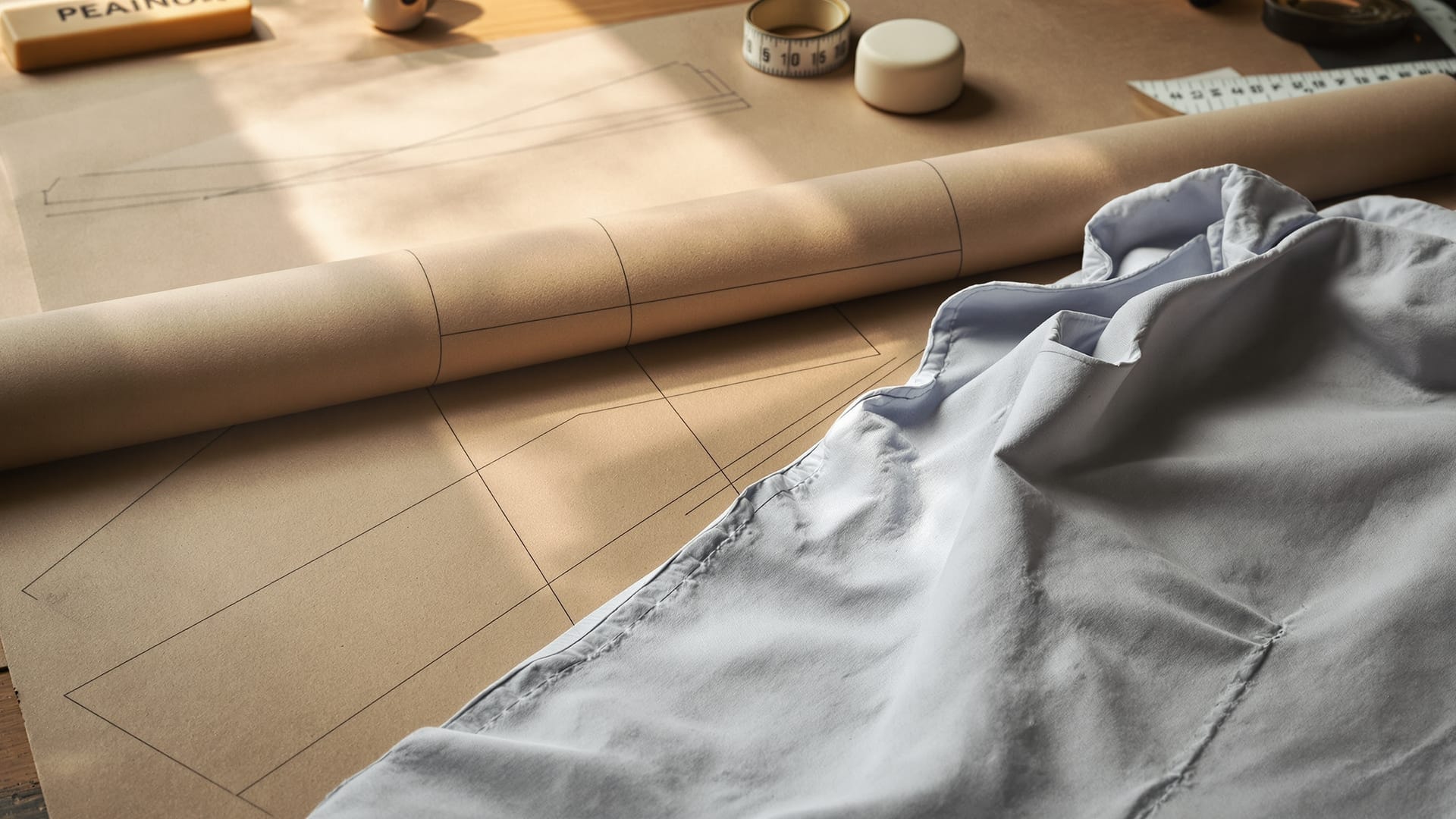
You'll find it to be convenient, as our tailors can either visit you at work or home, or you can supply us with your measurements. With a range of collar styles and over 200 fabrics to choose from, you will also be spoilt for choice. A pattern of your measurements will be retained for future orders.
The argument is a fair one and it has not dated. A suit jacket is worn over a shirt and forgives a good deal; a shirt is worn against the body, and the places where ready-to-wear compromises — collar height, sleeve length, the drop from neck to shoulder, the circumference through the waist — are precisely the places you notice all day.
How the service worked
Two routes. A tailor could visit at home or at work and take the measurements in person, or the customer could supply their own. Given that the house's whole business ran by post and internet, the second route was the common one, which is why its sizing instructions were written as carefully as they were — for a bespoke order they were not a guide, they were the specification.
Once cut, a pattern of the measurements was retained. That is the part that makes bespoke shirtmaking practical rather than an annual ordeal: the first order is the work, and every order after it is a choice of cloth against a pattern already on file. It also means that a fit can be adjusted incrementally — a half-inch off the waist, a fraction more collar — rather than re-measured from scratch.
What could be specified
- Over two hundred fabrics, far beyond the dozens of colourways carried in the ready-to-wear ranges.
- A range of collar styles — point, spread and the intermediate shapes, fused or with a woven interlining.
- Cuff type — single with buttons, or double for cufflinks.
- Body measurements — collar, sleeve, chest, waist and yoke, taken individually rather than paired by a size chart.
The terms
The service was priced per shirt and carried a minimum order of eight shirts. That minimum tells you what kind of proposition it was: not a way to buy one special shirt, but a way to replace a working wardrobe in one go and then repeat against the stored pattern. The business no longer trades, and its former prices would be misleading.
Bespoke, made-to-measure and the difference
The two terms are used loosely in the shirt trade. Strictly, bespoke means a pattern drafted individually from scratch, and made-to-measure means a house block adjusted to a customer's measurements. What Prowse & Hargood described — measurements taken, a pattern retained, a wide fabric choice, a minimum order — sits in the second category as most of the trade uses the words, and the house used both terms itself. The distinction matters less than what actually happens to the cloth, which is why it is worth knowing the vocabulary in the glossary before comparing any two offers.
If you are not ordering
Nothing here is available because the business has closed. What remains useful is the method — measure twice, round up on the sleeve, keep the pattern — and it applies to any shirtmaker. The sizing guide presents the house's instructions. For the broader history of bespoke tailoring practice in Britain, the Victoria and Albert Museum holds pattern and garment material spanning the trade.