This site is not a shop. Prowse & Hargood ceased trading and the company behind it was dissolved. This collection covers the house's shirts, cloth and craft. Nothing here is for sale, no order can be placed, and no prices, ordering routes or contact details are provided. More about Prowse & Hargood.
Cotton Socks
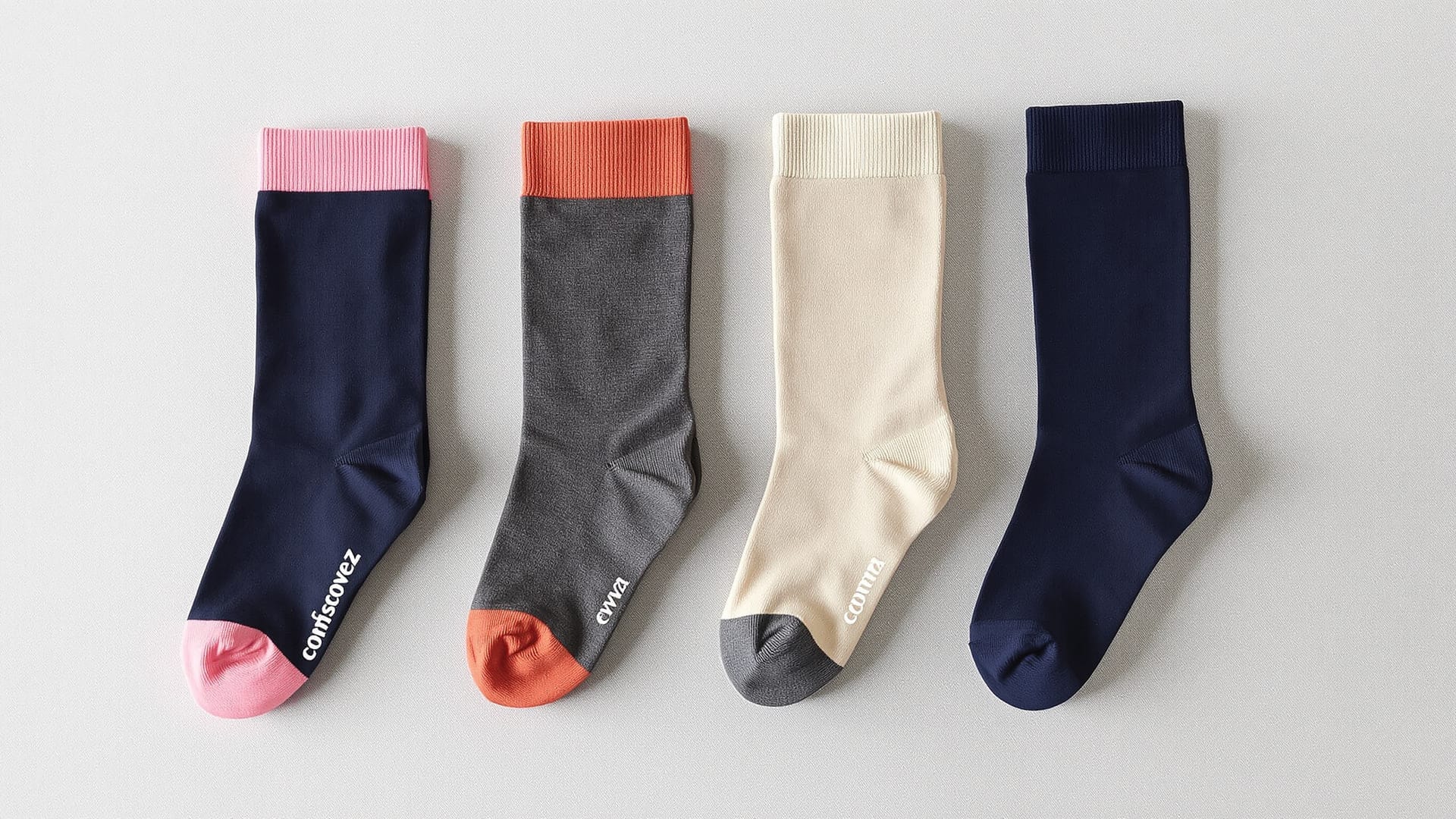
The smallest line the house carried, and the one that says the most about how it thought. A single catalogue page of cotton socks, offered in paired colourways rather than as plain basics — because a shirtmaker selling a whole way of dressing does not stop at the ankle.
The range
Four colourways were listed on the catalogue's only sock page:
- Heel and Toes — a contrast at the heel and toe against a plain leg, the oldest decorative convention in hosiery and originally a reinforcement rather than an ornament.
- Navy and Pink
- Charcoal and Begonia
- Beige and Wine
Every one is a pair of colours rather than a single one. That is a deliberate choice: a two-colour sock reads as a considered accessory in the same way a woven tie does, while a plain black sock reads as nothing at all. The pairings themselves are of a piece with the rest of the house's palette — navy, charcoal, wine, beige, with pink and begonia supplying the one warm note.
Why cotton
Cotton is the natural companion to a cotton shirt, and it behaves in the ways the house was already committed to: it takes dye cleanly, it is comfortable against skin in a way that synthetic filament is not, and it can be laundered hard. It is not the warmest fibre — wool holds far more air — but for a sock worn inside a shoe under a suit, breathability matters more than insulation.
The trade-off worth knowing is elasticity. Pure cotton has very little natural recovery, which is why almost all cotton socks include a small proportion of elastane or nylon in the welt to keep them up. That is a practical necessity rather than a compromise on fibre quality, and it is why a sock's cuff loosens with age faster than its foot wears through.
Wearing them
The conventional guidance for a business wardrobe is that the sock reaches the calf rather than the ankle, so that no bare leg shows when you sit down, and that it relates to the trouser rather than to the shoe. A contrast heel and toe or a two-colour ribbing is a quiet way to have a sock be worth looking at without departing from either rule — which is precisely the register this range was pitched in.
Care
Wash cotton socks with like colours at 40°C. Turn them inside out if the foot has picked up anything from the shoe. Avoid a hot tumble dry: the same heat-plus-agitation combination that shrinks a cotton shirt will also cook the elastane in the welt, which is what turns a good sock into one that slides down. Pair them before washing rather than after, and they will survive the machine in numbers. The wider principles are on the product care page.
Elsewhere
Socks sat alongside silk ties and cufflinks in the house's accessories offer, and were the sort of thing that made up its gift packs. The shirts they were meant to accompany are on the men's shirts page. For the properties of the cotton fibre itself, Encyclopaedia Britannica gives a straightforward account.