This site is not a shop. Prowse & Hargood ceased trading and the company behind it was dissolved. This collection covers the house's shirts, cloth and craft. Nothing here is for sale, no order can be placed, and no prices, ordering routes or contact details are provided. More about Prowse & Hargood.
Accessories
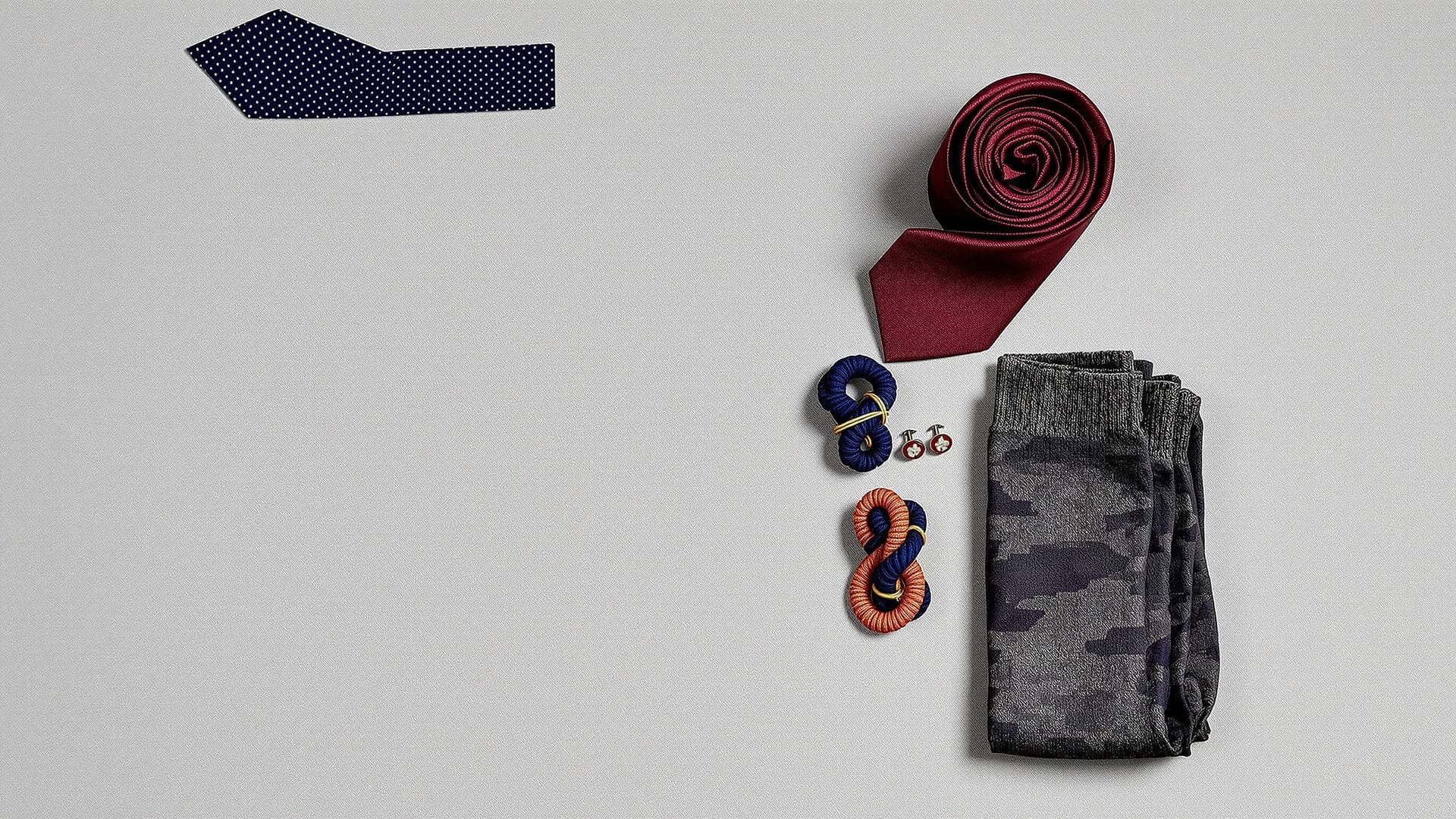
Three lines, plus a fourth that arrived late. The house treated ties, cufflinks and socks as part of the same wardrobe as its shirts rather than as an afterthought: cotton shirts, silk ties and silk knots.
Handmade woven silk ties
The largest accessory line by some distance: nine catalogue pages of woven silk, every tie 147 cm long and 9.5 cm at the blade, every one cut on the bias so it hangs straight and recovers overnight. The colourways ran to stripes, small geometrics, checks, paisleys and floral motifs in a navy-maroon-gold-brown palette chosen to sit with the Tewkesbury range. Full detail is on the ties page.
Cufflinks
Five pages of them, in mother-of-pearl, onyx, haematite, faceted crystal and cabochon cat's-eye stones, plus a group of patterned faces — gingham, herringbone, multi check — that deliberately echoed the shirting. They were a necessity rather than a flourish: the Tewkesbury shirts were made in double cuff and will not fasten without them. See the cufflinks page.
Silk knots
Silk knots became a category of their own in the later years of the business. They are the simplest cuff fastening there is: two small woven silk balls joined by a corded loop, passed through the buttonholes of a double cuff in place of a metal link. They are soft, weigh nothing, cannot scratch a desk or a cuff, and come in bright colour pairings that no metal cufflink can carry. Traditionally they were the informal option and the emergency option at once — the thing you kept in a drawer for the day a link went missing — and they have since become a standard alternative in their own right.
Cotton socks
A single page, four colourways, all of them two-colour pairings rather than plain: heel and toe contrasts, navy and pink, charcoal and begonia, beige and wine. Small, but consistent with everything else the house did. See the socks page.
Gift packs
The catalogue also carried assembled gift ranges — separate men's and women's packs built from the lines above, plus a general gift range. The gift ranges supported seasonal birthday and Christmas sales: pre-assembled combinations of a tie and cufflinks, or socks and a shirt, were easier to give than a single item from forty colourways.
How the offer fitted together
Read as a whole, the accessory range is an argument that the shirt is the centre of a way of dressing rather than an isolated purchase. Every line either fastens the shirt (cufflinks, silk knots), finishes it at the throat (ties), or completes the outfit it belongs to (socks). Nothing was sold that did not connect to something else in the catalogue. That is a small house's discipline, and it is the same discipline that kept the shirt ranges to two.
Elsewhere
The construction vocabulary — bias, blade, double cuff, mother-of-pearl — is defined in the glossary, and the care guide covers storing silk and washing cotton. For the fibre behind all of it, Britannica on silk is a clear general reference, and the Victoria and Albert Museum holds accessory collections spanning the period.