This site is not a shop. Prowse & Hargood ceased trading and the company behind it was dissolved. This collection covers the house's shirts, cloth and craft. Nothing here is for sale, no order can be placed, and no prices, ordering routes or contact details are provided. More about Prowse & Hargood.
The Tuscany Range
"The ability of the Italians to wear a shirt without a tie, whilst still appearing smart, is legendary." The Tuscany was the house's answer to that observation: a fitted cut with a higher, fused Italian collar, made for evenings and weekends rather than for the office.
The problem it solves
An ordinary dress shirt is designed around a knot. The collar's height, the stiffness of its interlining and the spread of its points are all calculated on the assumption that a tie will hold the two sides together and push them up. Unbutton it and the collar loses its structure: the points splay outward and the whole thing subsides into the neckline of a jacket.
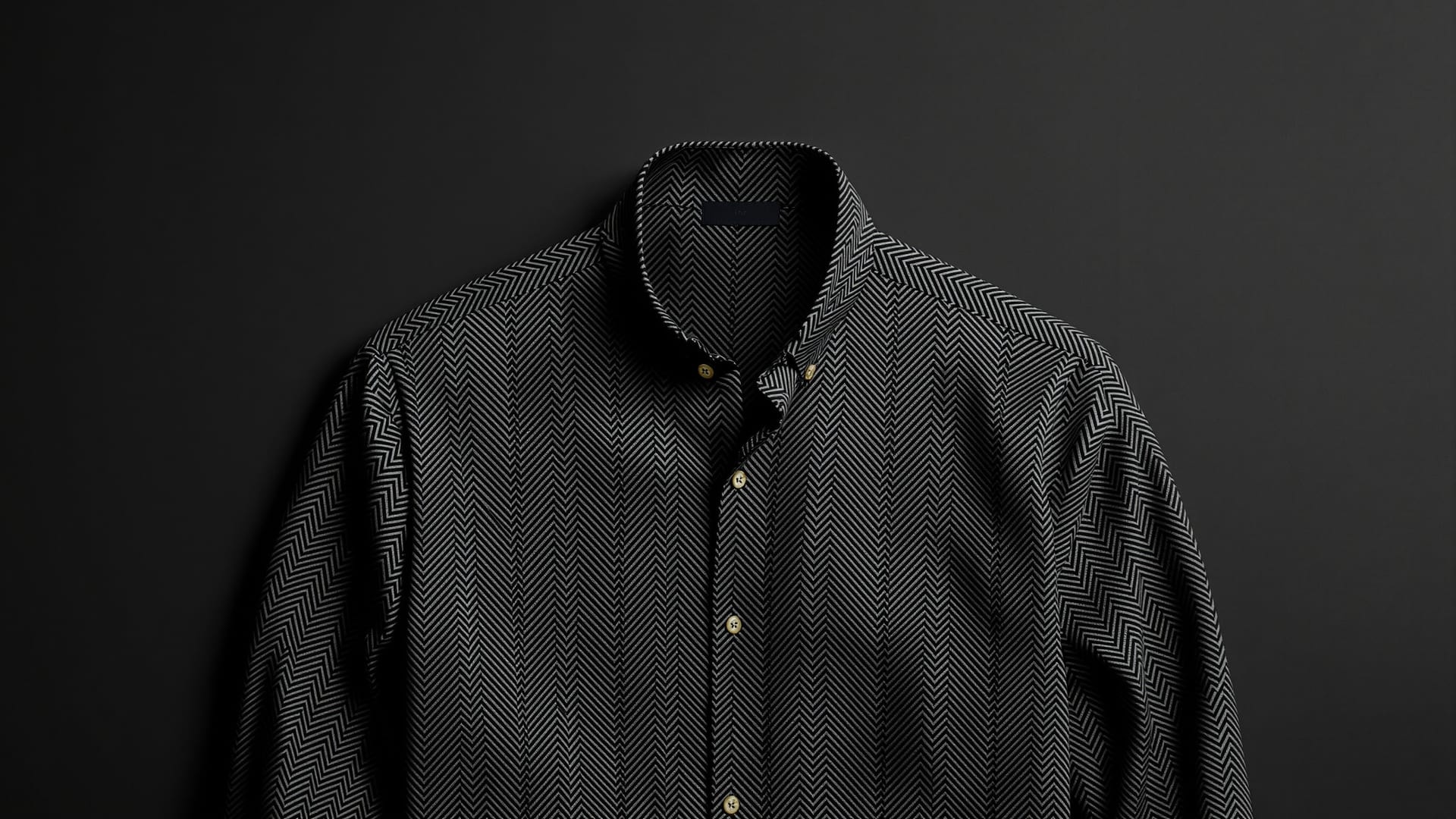
The Tuscany was cut the other way round. Its collar is fused rather than non-fused — bonded to its interlining, so it stands unaided — and it sits slightly higher on the neck, so that with the top button open it still frames the throat instead of falling away from it. The house's phrase for the result was "an altogether more relaxed look."
The cut
The body is closer than the classic Tewkesbury, described in the catalogue as an exclusive cut. In shirtmaking terms that means back darts — folds of fabric stitched to a point to remove excess through the waist, defined in the glossary — and a narrower sleeve, so the shirt reads as tailored when it is untucked or worn under a jacket without a tie. Being a fitted cut, it is less forgiving than the Tewkesbury, and the sizing guide is worth reading before choosing between the two.
The cloths
The Tuscany ran across three catalogue pages of colourways, weighted towards texture and towards greys and darks rather than towards the classic office blues:
- White Herringbone — texture without colour, the most formal cloth in the range.
- Grey Stripe, Navy Stripe, Blue Stripe, Red Stripe, Silver Stripe — woven stripes on a range of grounds.
- Black Royal Oxford — the heaviest and most lustrous cloth offered, and the one that carries the standing collar best.
- Charcoal Houndstooth — a jagged-edged check, at scale small enough to read as texture.
- Charcoal Herringbone — reversing twill in a dark ground.
- Pink Stripe — the one warm note in an otherwise cool group.
Royal oxford, herringbone and houndstooth are all weaves that generate their own light. That is deliberate for a shirt intended to be worn without a tie: with nothing at the throat to hold the eye, the cloth itself has to carry the shirt.
Fused and non-fused, honestly
Fusing is often written about as though it were simply the cheaper option, and in mass-market shirts it usually is. Here it is a design choice with a real trade-off. A fused collar holds a hard, clean line indefinitely and is the only kind that looks correct open; the cost is that the adhesive bond is the one part of a shirt that can fail on its own, typically as slight bubbling along the collar edge after enough hot washes. Washing at 40°C rather than higher, as the care guide instructs, is what keeps that from happening.
Wearing it
Open at the neck, ideally with nothing else competing for attention there. The house's ties and cufflinks were offered against the Tewkesbury; the Tuscany was the shirt for the days you left them in the drawer. It is the same two-fold long-staple cotton underneath — see men's shirts for how the ranges compare side by side, and the Britannica survey of textiles for how twill and basket weaves are constructed.