This site is not a shop. Prowse & Hargood ceased trading and the company behind it was dissolved. This collection covers the house's shirts, cloth and craft. Nothing here is for sale, no order can be placed, and no prices, ordering routes or contact details are provided. More about Prowse & Hargood.
Collar Fit and Comfort: Tight Collars, Ties and Eye Pressure
Start with the collar of a shirt and the knot of a tie. For a day in formal clothes, keep two questions separate: how you want the collar to fit, and what an experiment can tell you about the body. The neckwear studies below measured particular responses under particular conditions; read those conditions alongside the findings.
Room at the collar
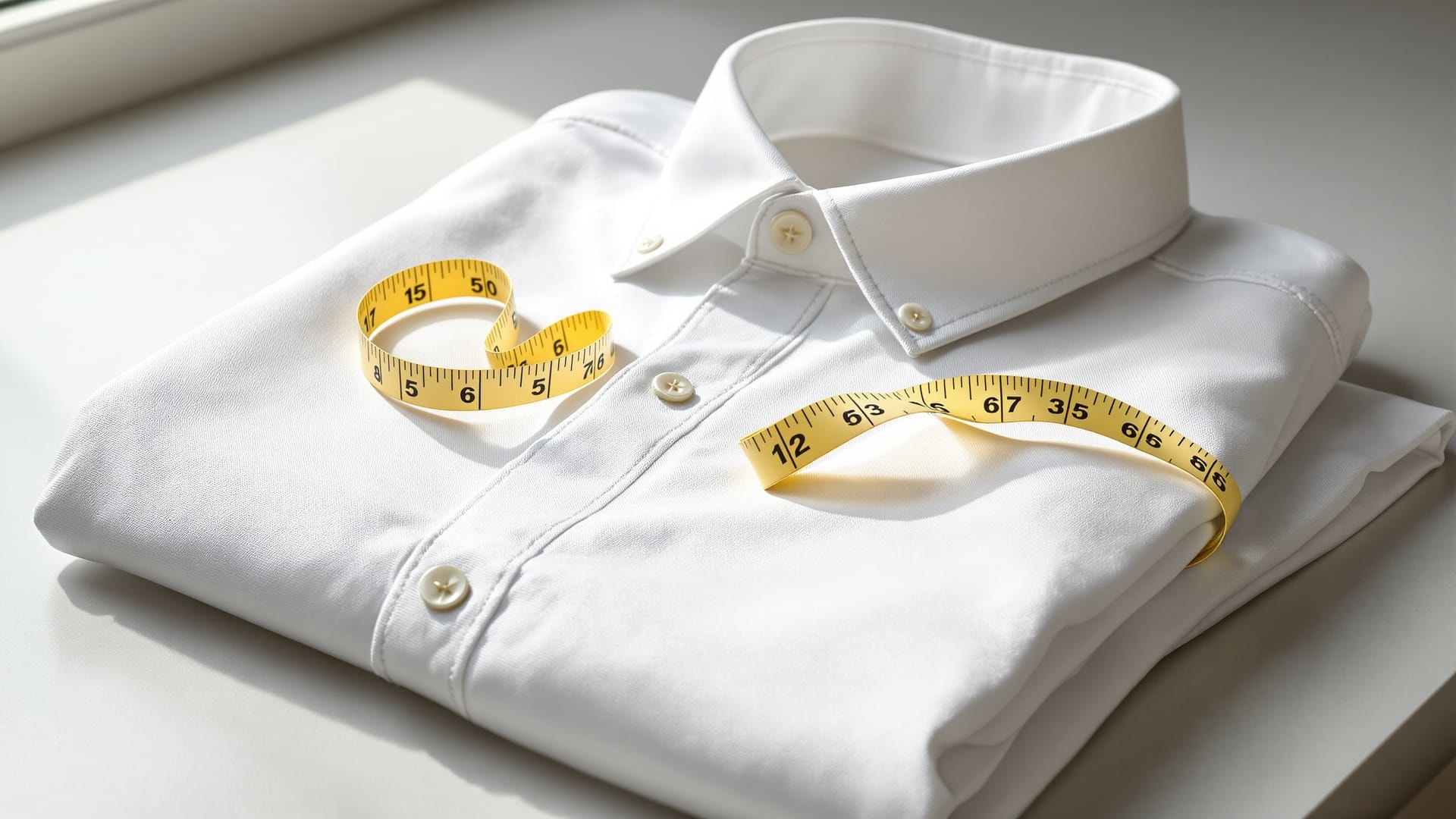
For the tape-measure instructions, use the collar and sleeve sizing guide. When reading about a tight tie, ask how the neckwear was arranged and how long it was worn. In one pilot study, researchers simulated a tie with an inflatable inner tube and a pressure gauge, comparing it inflated and deflated after five minutes. Keep that arrangement in mind when thinking about the shirt and tie in front of you.
Read the studies as accounts of measurements, keeping each finding beside the conditions in which it was recorded. The pilot's five-minute comparison and the MRI examination described below concern their experimental conditions. For an ordinary working day or a formal evening, be cautious about turning either into a promise about what a particular fit will do.
What eye pressure means
The National Eye Institute explains that pressure rises when fluid cannot drain normally from the front of the eye. There is a space between the cornea, the clear front layer, and the iris, the coloured part of the eye. Fluid normally passes through this space and leaves through an opening where the iris and cornea meet, draining through spongy tissue there.
The Institute describes glaucoma as a group of eye diseases that can damage the optic nerve at the back of the eye, causing sight loss and blindness. It says that higher eye pressure is associated with greater risk of glaucoma, but the relationship is not a simple division into high pressure and normal pressure. Some people with high pressure do not develop glaucoma; some with normal pressure do. Keep both parts of that explanation together when reading a report about a pressure change.
What the neckwear evidence establishes
The 2018 necktie study in Neuroradiology noted earlier evidence that wearing a necktie increased intraocular pressure, the pressure inside the eye. Its own investigation used MRI to examine cerebral blood flow and jugular venous flow. That distinction matters when reading a headline about a collar: the paper's reference to eye pressure and the measurements made in its own experiment should be read separately.
For the shirt wearer, keep the question precise. Was the finding about pressure inside the eye, blood flow during an examination, or the breath hold index used in another experiment? Put the measurement back beside the result before drawing a conclusion about everyday neckwear. The National Eye Institute's account includes both people with high eye pressure who do not develop glaucoma and people with normal pressure who do.
Circulation experiments need careful reading
The randomised crossover pilot of simulated neckties enrolled 40 healthy male volunteers. It compared cerebrovascular reactivity with the inflatable "pseudo-tie" worn inflated or deflated for five minutes. Reactivity was calculated using the breath hold index, or BHI. The mean index was 1.44 with the loose arrangement and 1.21 with the tight one, a reduction of 0.23 units. The researchers reported reduced reactivity, while noting that the mean BHI remained within a range considered normal.
The authors recommended confirmatory work. Read the population, the apparatus and the five-minute period as part of the result. Keep the reported reactivity measure distinct from the blood-flow measurements in the next study.
The 2018 MRI study of neckties and cerebral blood flow involved 30 volunteers divided into two groups: one examined with a tie and one without. The examination found a statistically significant decrease in cerebral blood flow after the tie was tightened, while jugular venous flow showed no significant change. This was a small study of measurements during an examination; keep that short-term setting in view. Its finding should not be turned into a prediction about years of wearing a shirt to work.
A different experiment with a neck compression collar involved eight healthy young men and eight healthy young women. Researchers examined responses with and without a specialised collar during paced deep breathing, a Valsalva manoeuvre and head-up tilt. They recorded heart rate, beat-to-beat blood pressure and other measurements, and used ultrasound images to measure the cross-sectional area of the carotid artery and jugular vein. The researchers reported effects on brain blood flow in women. They detected no effects of sex or collar on responses to deep breathing, and no collar effect on cerebrovascular function or heart rate variability during upright tilt. Treat this specialised equipment as experimental context when thinking about an everyday shirt collar.
A pressure reading is part of an examination
In its statement on glaucoma detection, the National Eye Institute explains that tonometry measures intraocular pressure. Because what counts as normal pressure varies between individuals, this test alone is insufficient for an accurate diagnosis. The Institute notes that screening with tonometry alone can produce positive results in people without glaucoma and negative results in people who have it.
The Institute's guide to a dilated eye examination describes checks beyond pressure. Visual acuity testing checks how clearly you see, using letters at near and far distances. Dilation widens the pupil so the eye professional can look inside the eye. Other tests may be included according to individual needs.
Keeping fit and research in perspective
For the next occasion that calls for a collar and tie, return to the sizing instructions for measurement and to the studies for their actual findings. Keep the different experiments separate: the inflatable simulated tie, the MRI examination with neckties and the specialised compression collar. For eye examinations, the National Eye Institute says the appropriate frequency depends on individual risk of eye disease and advises discussing what is right for you with an eye professional. That is the personal question its guidance addresses; leave the neckwear experiments within the limits of what they measured.